1960s
In 1969, packet-switching (PS) networks is developed and completed. ARPANET (Advanced Research Projects Agency Network) thus became the first real network to use the PS technology. Computers at Stanford and UCLA connected for the first time and became the first hosts for the future Internet.An operating system known as UNIX was also developed and it influenced the development of Linux and FreeBSD in the 1990s.
1970s
In 1970, an ARPANET network was established between Harvard, MIT, and BNN. This eventually led to the establishment of the first connections over an ARPANET. By 1971, there are 23 hosts (15 nodes) connected.
Ray Tomlinson also began the development of Email in 1971, which proves to be an efficient way to send messages over a network. Michael Hart realized the future of computers is on the storage, retrieval and searching for information that was only available in print at that time.
Thus, he started Project Gutenberg, which gave birth to eBooks and enables documents to be made available online for free electronically.

In 1972, an ARPANET-like project, known as CYCLADES was started by France. It pioneered the key idea that the host computer should be responsible for data transmission instead of the network itself.
In 1973, the University College of London connected to the ARPANET networks. It was the first trans-Atlantic connection. Email also became more popular as it accounts for 75% of ARPANET network activity.
In 1974, a proposal was published which linked ARPANET-like networks together into an “inter-network”. It marks the beginning of TCP/IP, or transmission control protocol, developed by Vinton Cerf.

In 1975, a programmer named John Vittal created and developed the first email client program. It features the functions of replying and forwarding.
In 1977, developers Dennis Hayes and Dale Heatherington created the first PC Modem. It was then sold to computer hobbyists. The PC Modem was a huge breakthrough in the development of the Internet we know today.
In 1978, the first Bulletin Board System (BBS) was developed in Chicago. Gary Thuerk became the first person to send the first unsolicited email message to 600 other ARPANET users in California. This was later known as “spam”.
In 1979, the first multiplayer game, MultiUser Dungeon (MUD) was developed. It is a text-based virtual game featuring role-playing games, interactive, fiction and online chat. In the same year, Usenet was created by two graduate students. It was an internet-based discussion system, allowing people from around the globe to converse about the same topics by posting public messages categorized by newsgroups.

1980s
In 1982, Scott Fahlman proposed the idea of using : -) as an emoticon when saying a joke. This thus marks the birth date of modern emoticons which are widely used on the Internet today.
In 1984, the domain name system was created along with the first Domain Name Servers (DNS). This domain name system made addresses on the Internet more user-friendly compared to its numerical IP address counterparts. DNS servers allowed Internet users to type in an easy-to-remember domain name and then converted it to the IP address automatically.
In 1985, Stewart Brand and Larry Brilliant developed the Whole Earth ‘Lectronic Link (WELL), a virtual community where readers and writers of the Whole Earth Review had open gatherings.
In 1986, a protocol war broke out between Europe and the United States. The Europeans pursued the Open Systems Interconnection (OSI) while the Americans used the Internet or ARPANET protocol, which won in the end.
In 1987, there were nearly 30000 hosts on the Internet. The adaptation of the TCP/IP protocol made larger number of hosts possible compared to only 1000 hosts on the ARPANET.
 In 1988, Internet Relay Chat was first developed. This was the first step into real time messaging and chat rooms. In the same year, Robert Tappan Morris developed an Internet worm, also known as “Morris Worm”. It was the first Internet-based malicious attack that caused major interruptions over large parts of the Internet.
In 1989, the American Online (AOL) was born. This was following the event that Apple pulled out of the AppleLink program, causing it to be renamed. It is popular among average Internet users.
1990s
In 1990, the idea of the world-wide web was proposed, written by Tim Berners-Lee. Protocols and standards such as HTML, HTTP and URLs are also written in the same year. "The World" then went on to become the first commercial dial-up Internet provider. Following these events, the ARPANET also ceased to exists.
 In 1991, the first webpage was created. Users who went to the web page will see that it explains what the world wide web is. "Gopher", a search protocol was launched which examines file contents instead of just file names. MP3 files was accepted as the standard audio file type. The first webcam was also deployed at Cambridge University.
In 1993, the first graphical web browser, known as "Mosaic" was released to the the general public. It features an easy use navigating system for non-techies. In the same year, governments also went online, giving birth to the domain names ".org" and ".gov".
In 1994, Mosaic's competitor in web browsing, "Netscape Navigator" was born.
In 1995, "Secure Sockets Layer" (SSL) encryption was developed by Netscape, making financial transactions more secure. This also marks the commercialisation of the Internet. "eBay" and "Amazon.com" was born and expanded their business online. JavaScript was also first introduced and developed by Brendan Eich. ActiveX was launched by Microsoft.
In 1996, Hotmail, the first web mail service was launched.

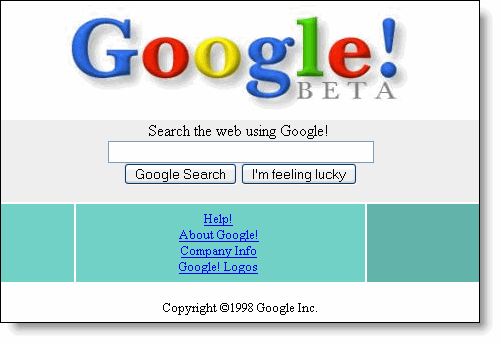
In 1998, Google was launched and it revolutionise the way people look for information online.
2000s
In 2001, Wikipedia was launched, providing for collective web content contributed by the public.
In 2003, MySpace was launched. It soon became one of the most popular social networking sites.
In 2004, Facebook opened its doors to college students. It surpasses MySpace to become one of the busiest website in the world.
In 2005, YouTube was created where user generated videos are hosted for sharing to the masses.

In 2008, the US Presidential Election was held online. Voters made full use of the Internet to poll and the candidates make use of online services such as YouTube, Facebook and Twitter to gain the support of the people.

With the advancement of technology, the Internet is advancing at the swiftest pace man has ever encountered. The future of the Internet depends on the events of today. Will the Internet turn into such a big 'net' that it engulfs mankind? Or will it go down as a flop in the history of man? The future of the Internet sets to be mystery and only time will uncover for us the truth behind it.

No comments:
Post a Comment